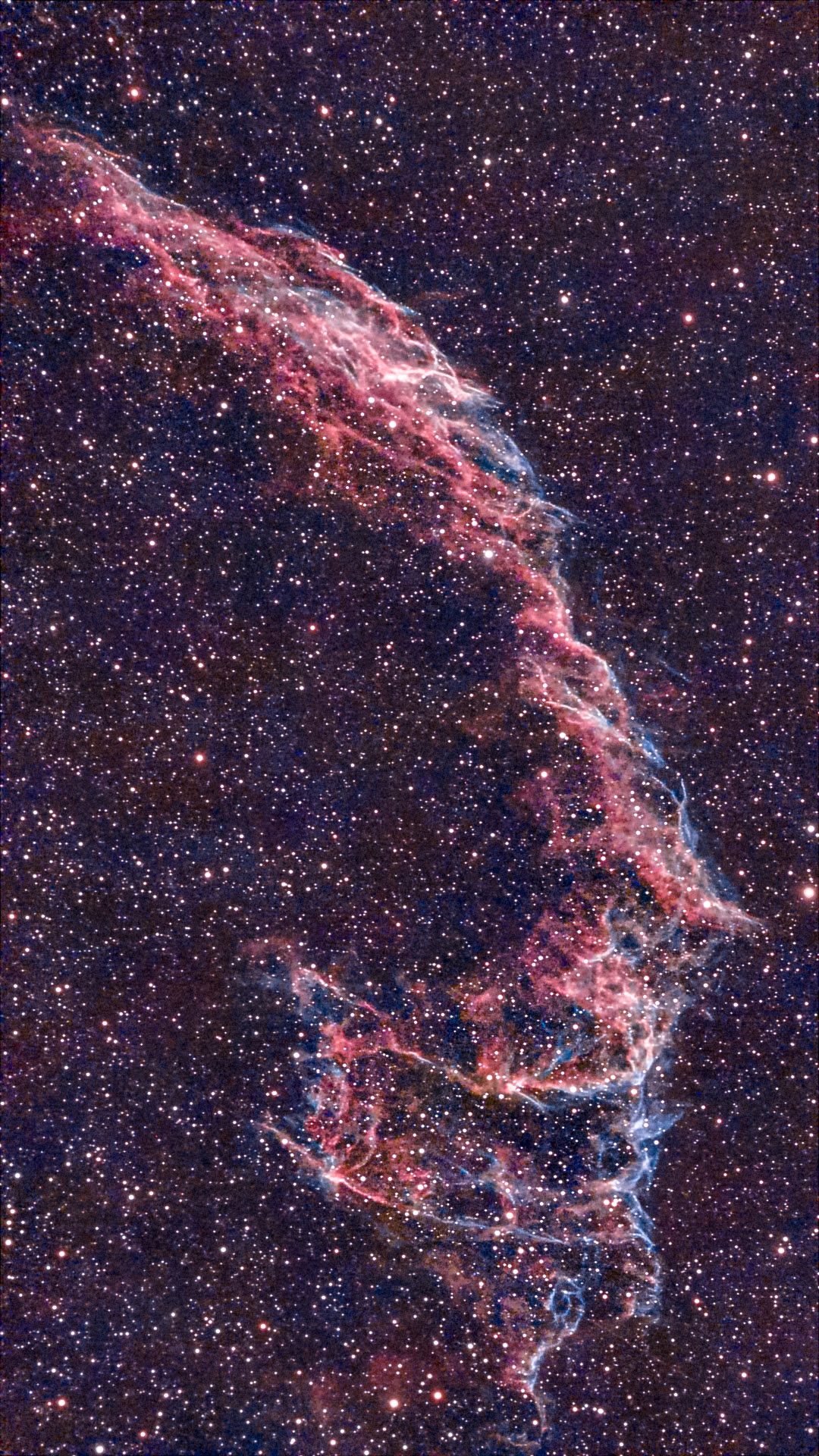
Located approximately 2,400 light-years away in the constellation Cygnus, NGC 6992, known as the Eastern Veil Nebula, is one of the most breathtaking sections of the Cygnus Loop Supernova Remnant. This vast structure is the aftermath of a massive star that exploded in a supernova approximately 10,000 to 20,000 years ago. Since that cataclysmic event, the expanding shock wave has continued to sweep through interstellar space at hundreds of kilometers per second, compressing and heating the surrounding gas until it glows. The remarkably thin filaments visible in this image are actually shock fronts seen nearly edge-on. Although they appear fragile, they stretch across dozens of light-years and preserve the visible imprint of one of the most energetic stellar explosions in our Galaxy. The entire Cygnus Loop spans nearly 120 light-years. The red emission is dominated by ionized hydrogen (Hα), while the striking blue-green filaments are produced by doubly ionized oxygen (O III), excited by the extreme temperatures generated behind the expanding shock wave. This image captures one of the finest supernova remnants in the night sky, illustrating how dying massive stars recycle heavy elements into the interstellar medium, providing the raw materials from which future stars, planets, and ultimately life itself are formed.