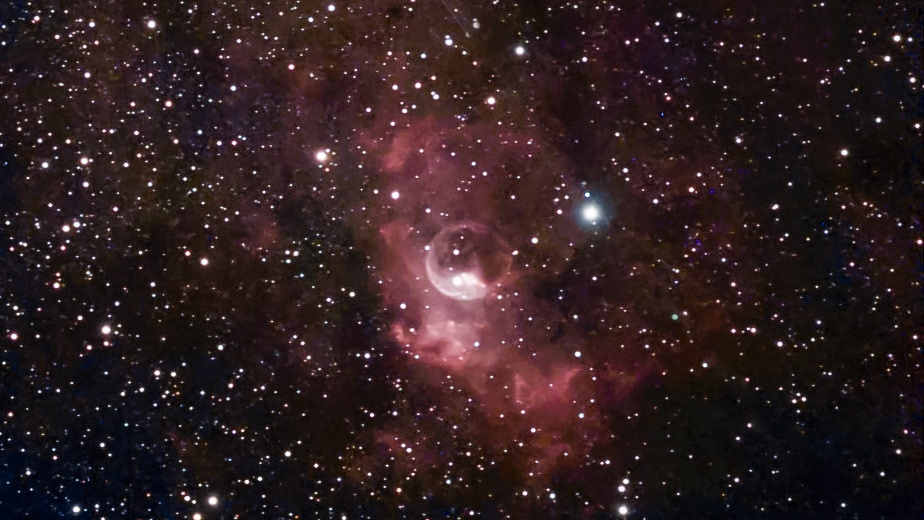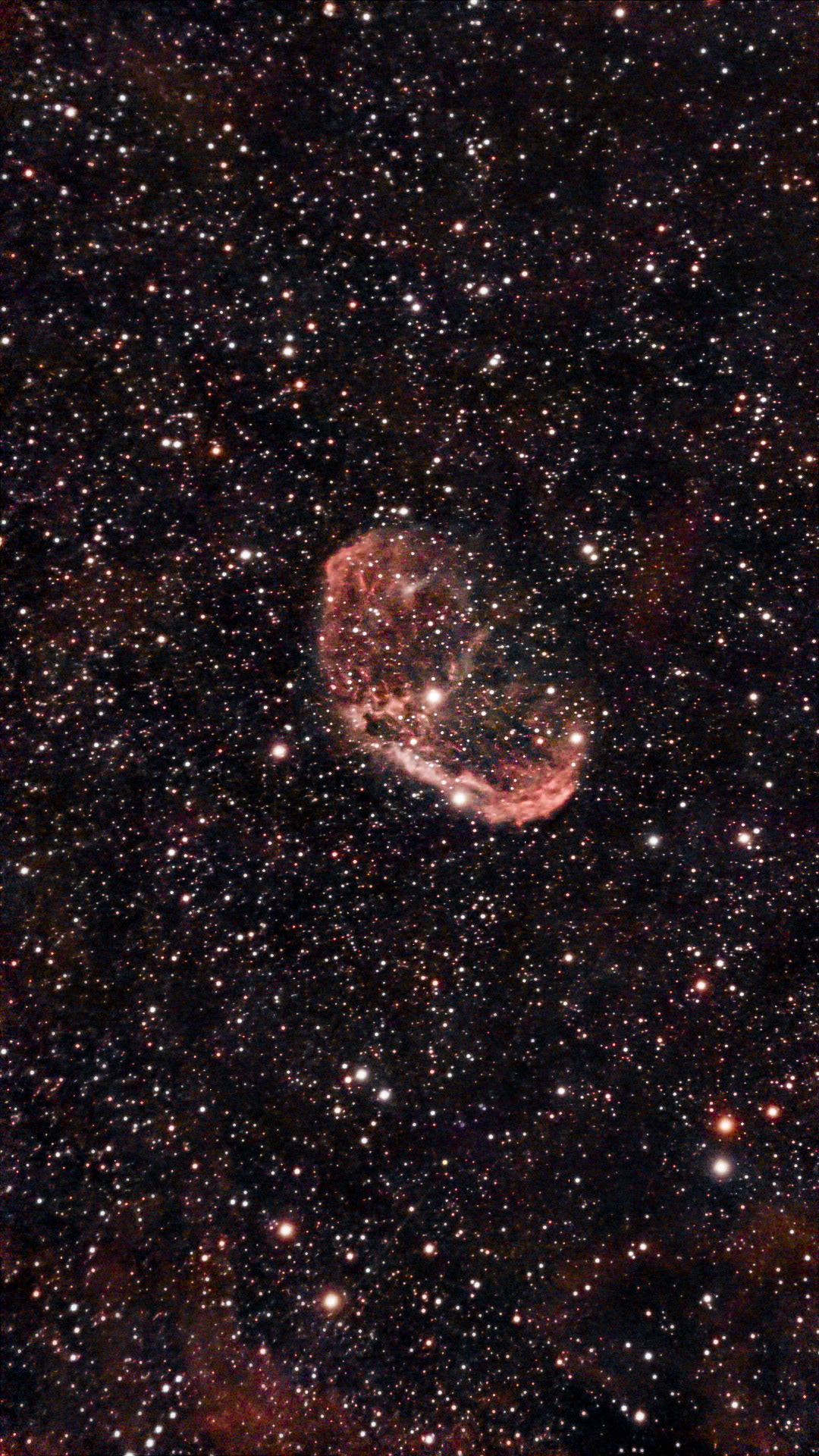
Located approximately 5,000 light-years away in the constellation Cygnus, NGC 6888, also known as the Crescent Nebula, is a spectacular emission nebula formed by the powerful stellar winds of the massive Wolf–Rayet star WR 136. Having exhausted the hydrogen in its core, WR 136 has entered one of the final stages of its evolution. It ejects its outer layers at speeds exceeding 1,500 km/s, generating a shock wave that collides with material expelled during an earlier red supergiant phase. The result is an intricate shell of compressed gas glowing brightly in hydrogen, oxygen, and sulfur emissions. Spanning nearly 25 light-years, the Crescent Nebula is a striking example of how massive stars shape their cosmic environment long before ending their lives in a supernova explosion. The elements forged within these stars will eventually enrich the interstellar medium, providing the building blocks for future generations of stars, planets, and potentially life itself. This image captures the delicate filaments and complex shock fronts that reveal the immense forces at work within this stellar bubble, preserving a brief yet extraordinary chapter in the life of one of our Galaxy's most massive stars.