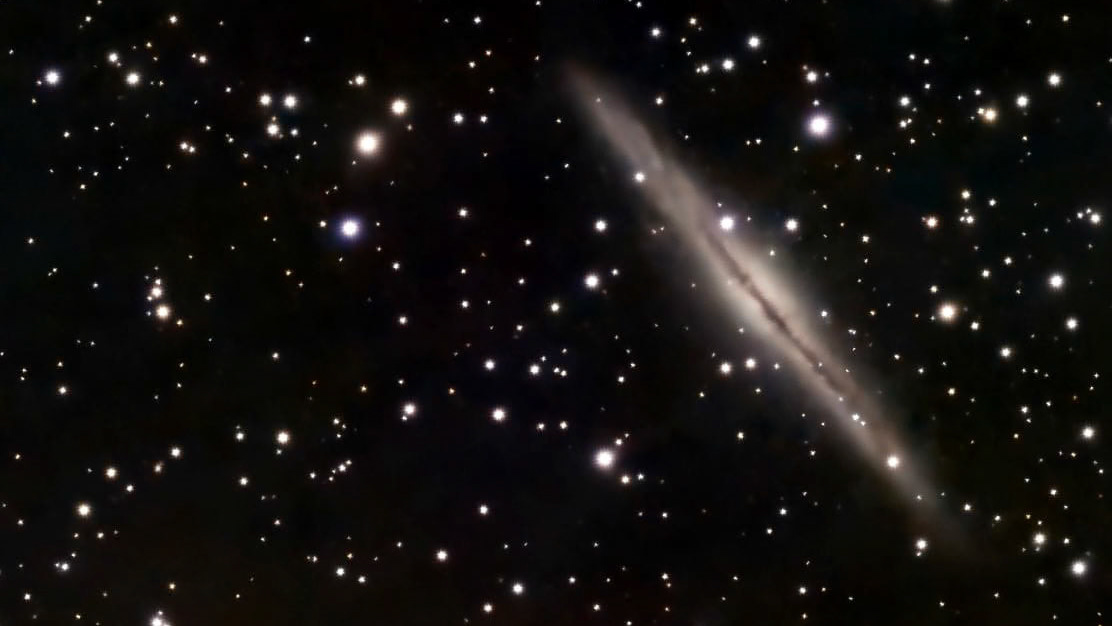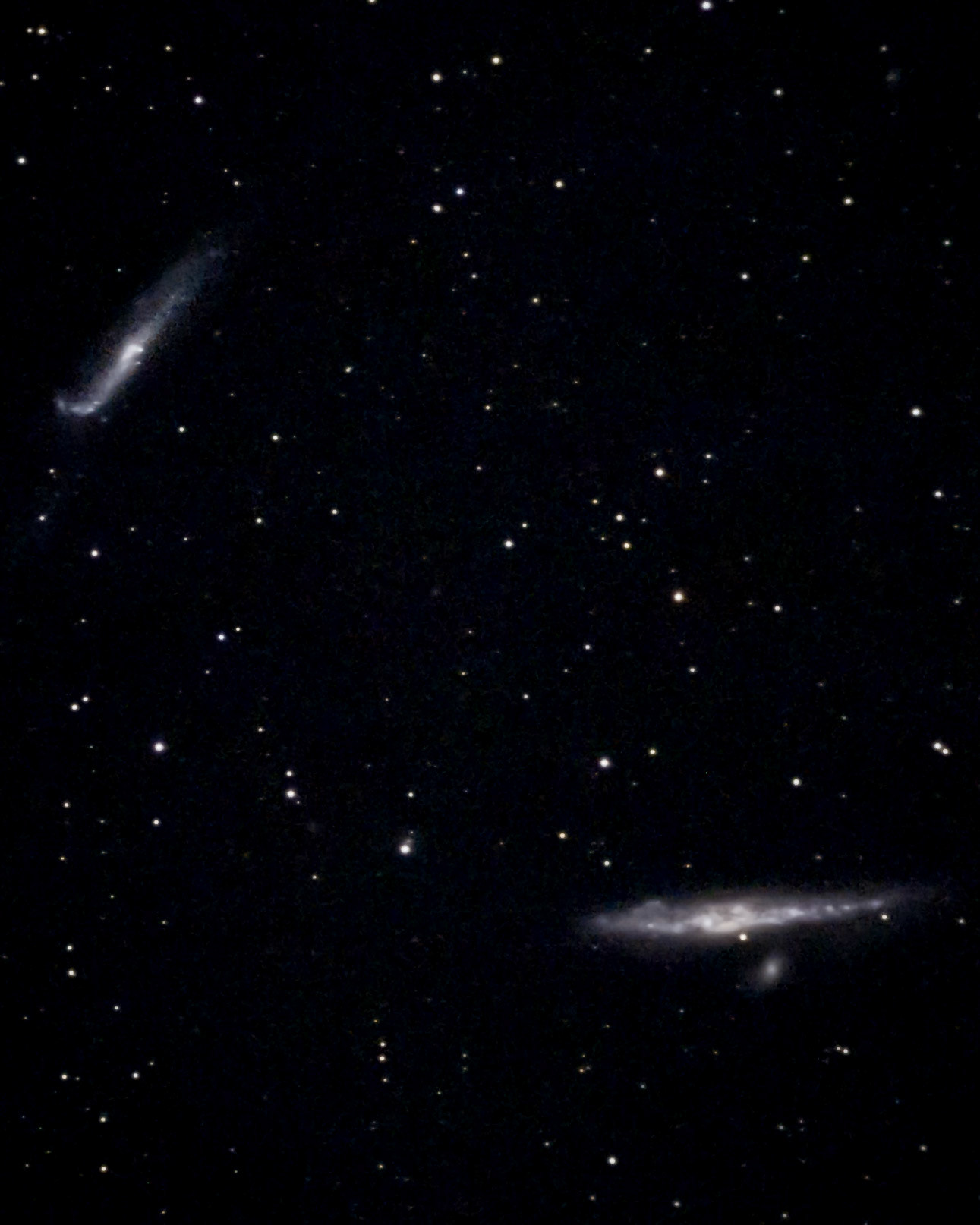
NGC 4631 — The Whale Galaxy 🐋✨ Suspendue à environ 25 millions d’années-lumière dans la constellation des Chiens de Chasse (Canes Venatici), NGC 4631, surnommée la Galaxie de la Baleine, traverse silencieusement l’immensité du cosmos avec sa silhouette allongée caractéristique. Vue presque parfaitement par la tranche (edge-on) depuis la Terre, elle révèle un disque déformé traversé de sombres bandes de poussière et de vastes régions de formation stellaire. Sa forme légèrement incurvée n’est probablement pas un hasard : les astronomes pensent qu’elle subit depuis longtemps des interactions gravitationnelles avec ses galaxies voisines, notamment sa petite compagne NGC 4627, visible juste au-dessus de son disque. Plus loin dans le champ apparaît également NGC 4656, la mystérieuse Hockey Stick Galaxy, rappelant que les galaxies évoluent rarement seules dans l’Univers. Cette image a été réalisée à partir de 496 poses de 20 secondes, représentant un total de 2 h 45 min d’intégration, afin de capturer les faibles détails de cette immense structure cosmique et les nuances de son environnement galactique. Ce que l’on contemple ici n’est pas simplement une galaxie lointaine, mais une véritable cité stellaire contenant des centaines de milliards d’étoiles, dont la lumière a voyagé pendant 25 millions d’années avant d’atteindre mon télescope. Une baleine cosmique nageant dans l’océan silencieux de l’espace. NGC 4631 — The Whale Galaxy 🐋✨ Drifting through the depths of the constellation Canes Venatici, approximately 25 million light-years away, NGC 4631, better known as the Whale Galaxy, stretches across space with its striking elongated shape. Seen almost perfectly edge-on from Earth, this spiral galaxy reveals dark dust lanes cutting through its disk, along with vast regions of active star formation glowing across its structure. Its slightly distorted appearance is far from accidental. Astronomers believe NGC 4631 has been shaped by long-term gravitational interactions with nearby galaxies, especially its small companion NGC 4627, visible just above the galactic disk. Also present in the field is NGC 4656, the fascinating Hockey Stick Galaxy, a reminder that galaxies rarely evolve in complete isolation. This image was created using 496 exposures of 20 seconds each, totaling 2 hours and 45 minutes of integration time, carefully revealing the faint structures and subtle details hidden within this distant galactic system. What appears as a faint streak of light in the night sky is, in reality, an immense stellar metropolis containing hundreds of billions of stars, whose light began its journey 25 million years ago before finally reaching my telescope. A cosmic whale swimming silently through the dark ocean of space.